Apollo vs Artemis: How the Earth changed in 58 years
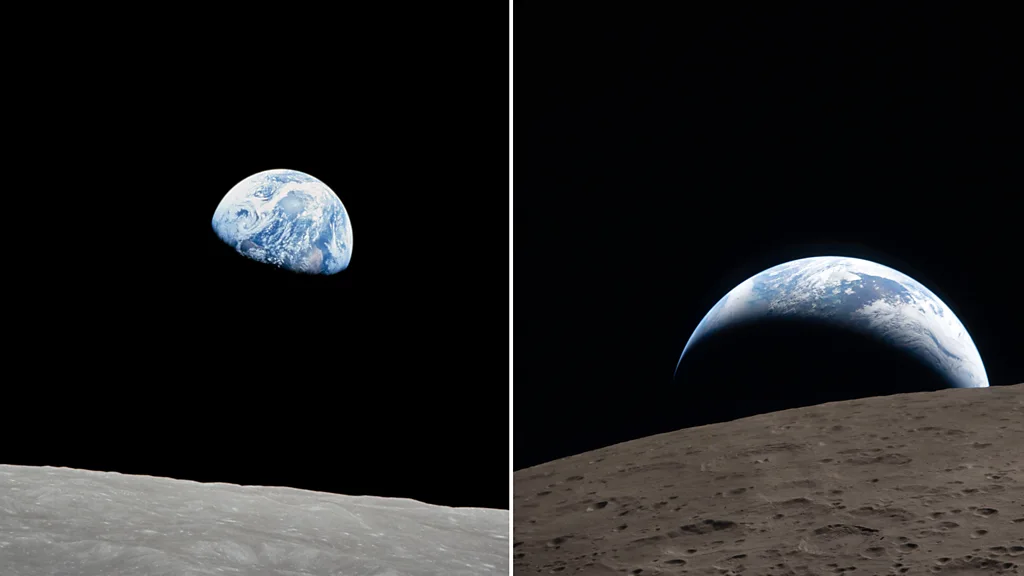
After the Apollo 8 crew captured the iconic Earthrise photo in 1968, Artemis astronauts have recreated the image, revealing changes to our fragile blue planet.
When the commander of Apollo 8, Frank Borman, first saw the far side of the Moon from his spacecraft window in 1968 he was struck by its desolate appearance.
“The lunar surface was terribly distressed with meteorite craters and volcanic residue,” he told me during a BBC interview in 2018. “It was either grey or black or white – there was absolutely no colour on the lunar surface, and it was messed up beyond belief.”
But as the spacecraft completed its fourth lunar orbit, suddenly, a very different view appeared.
“We looked up and there was the Earth in the background coming over the lunar surface, and Bill Anders took the picture that became probably one of the more significant pictures that humans have ever taken,” Borman said.
“The Earth was the only thing in the entire Universe that had any colour, it was a remarkable sight – we’re very, very fortunate to live on this planet.”
This Earthrise picture, as it was soon named, became one of the most reproduced images of all time. Showing our planet in the context of the lunar wasteland and vast oblivion of space, it galvanised the environmental movement, leading to the creation of Earth Day in 1970. (Read more about the 1968 photo that changed the world).
Fifty-eight years later, Nasa astronauts have taken another striking photo of the Earth dipping below a barren lunar landscape: “Earthset”. During their fly-by of the Moon earlier this month, the Artemis II crew captured the new image of our fragile blue planet in the vast expanse of space. (We don’t know who took the picture this time because the four astronauts have chosen not to credit photos to individuals but to the whole crew).
In geological terms, just over half a century is barely the shadow of a blink of an eye. But climate change has altered the Earth’s surface significantly over the past six decades. Experts tell the BBC about the visible differences between the Earthrise and Earthset photos and what these tell us about our planet then and now.
Despite its impact and legacy, what’s so surprising about the Earthrise picture is that no one at Nasa had seen it coming. “They caught it by accident, right?” says US astronaut Sian Proctor, the pilot for the first wholly “civilian” mission to space (named Inspiration). “Apollo 8 changed the way we saw our planet and that’s the kind of thing I feel like we need right now, more inspiration.” [Continue reading…]